Tuesday, November 28, 2006

2 days left to order painterly portraits


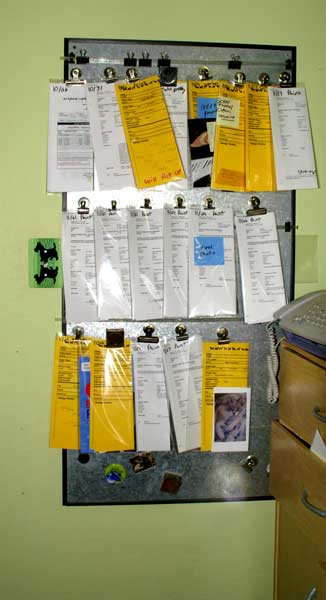
Wow, this month has flown by. There are only 2 days left to order our painterly style portraits ... yes, because I am still the only one here doing that style. I am planning to be pretty strict on the deadline this year. As you can see from the snapshot of my pending board the orders have been coming in all month long. The pending board represents about half of the work we have in-house. We also have a wall-pocket for revisions and the to-be-printed stack. The Warhols and Master Paw print styles have a deadline of 12/04 and that is next Monday! Local Dallas clients can always call us to see if we can squeeze them in at the last minute since shipping is not an issue. I really thought we were going to be a tad bit slower this year, however it is not stacking up that way. Ah well, not to worry .... we will get everyone proofed and printed very soon.

Monday, November 27, 2006

A New Pet Portrait Artist Blog


I heard from a another portrait artist the other day and she is an old e-mail buddy that actually did our dog Atticus in acrylic a year ago. I commissioned her to do something for Dan after Atticus passed. Anyway, check out Linda O'neill's new blog. Please visit her pet portrait blog and post a comment or two. Linda is a very talented portrait artist working in Colorado. I just ordered some Atticus Greeting cards from her. I was so thrilled to see she had chosen to include our boy in her new line of cards.

We were also surprised and elated to see our Pixel in Kathy Weller's new doggy calendar. She is even Miss January ...what an honor! I am going to purchase that calendar right now. I have often wondered how my clients feel when they find their pet's artwork on gift items at our site .... now I know ... it is pretty darn cool. It is really fun to be the client!


Many thanks to both of these talented women for their friendship and inspiration. And thanks for immortalizing my fur-kids.

Between us (and the body). Shen Wei


A Chinese photographer moves to the U.S. Here, he discovers bodies. Bodies as social places. Bodies as identifiers, as the places of definition. How does the place one belongs to relate to the body one owns (isn't this a beautiful expression? to own a body...)?
Shen Wei's series Almost Naked is a guided tour of identity caught in body. Or of the body as caught up in identity. Whichever way you put it, there is a feeling of self, that is, that the pictures are not of the person's body, but of a person as she reveals/hides herself. There is a certain foreigner's curiosity of how the others deal with who they are, what they are, and what they can present to someone else. This curiosity, and the way the subjects deal with it, is one of the most delightful aspects of Wei's work.
There is sometimes a feeling of a dangerous zone, of a fragile state that almost makes one look away, as if there was something indecent about showing oneself. As if it were an exposition and not a capturing of something. Then again, curiosity is stronger and I dare you not to look at all the pictures with great attention. The attraction of intimacy, combined with a gentle sense of humor, is right on the spot. Shen Wei says:

Once I achieve the trust of the model, I can feel their energy and their desire to be seen and be explored but at the same time still reserve some for themselves. It is in those Almost Naked moments that my subjects are the most exquisite, when things occur, and what generally is not displayed initially in public is exposed. I emotionally and physically strip the sitters when the trust and friendship is built between us. The key to building that trust and friendship is to make them feel at ease with conversation and personalized emotion contact. It can sometimes be psychological, sometimes more sensual, sometimes more or less sincere, depending upon the personality of the sitters and the intimate level of the environment. It is the art of psychology within making art.


None of the people smile.

I found this through the placebokatz blog, which to my great joy (as always when that happens) has put a link to this humble page.

Saturday, November 25, 2006

Yinka Shonibare and the artist's freedom

Yinka Shonibare, Scramble for Africa (2003)

Shonibare's most famous works play on the idea of origin and power. The first lecture is clear: headless people are scrambling for Africa. They are dressed in European clothes, but made of African fabric. They are false. But this goes further. The type of cloth they use, called batik, is used throughout Africa (and not only) and considered a local tradition. But, as Shonibare says, that is not the case:
...the fabrics are not authentically African – they were produced by the Dutch in the 19th century and then subsequently by the English for sales to the African market.
That makes the situation even more absurd and scary. What is left of Africa? And what can be left for Africa?

But there is another issue related to Shonibare that has been interesting me more. The freedom of the artist vs. the necessity of his functioning well in the system.
Let's start off with this:

Yinka Shonibare, The Swing (after Fragonard) (2001)

How much does the artist need to know about what he is doing?
And really the idea behind it is to draw a parallel with the relationship between the contemporary first world and third-world countries. I want to show that behind excessive lifestyles there are people who have to provide the labour to make this kind of lifestyle happen.

But generally I think I made a piece of work about this painting because I actually admire the work very much. And I like the contradiction of taking something that’s supposedly ‘ethnic’ and putting that onto classical European painting.

All this seems fairly light, naive, compared to what the critics have to say about Yinka Shonibare's works. Does this mean he is unaware of the worlds he is creating? Is he simply using strong imagery that brings about a huge load of references? Possibly. Does that change anything? Does that make him a worse artist? Should the artist be his own critic? Should he be a philosopher as well?

Obviously, the artist part of being an artist is to make art. And then, see what happens. That's in the ideal world. In the one I know, the artist also sells his product, by being who he is, by having the life he has, by speaking the way he speaks. This doesn't signify the impossibility of defending oneself through work alone, but certainly makes it all the more difficult. And brings another issue.

What if Yinka Shonibare didn't make contemporary ethnic art? What if his work were just contemporary, and dealt with, say McDonald's or sex or any other issue? And let's imagine, for the sake of the argument, that it weren't any worse than what he is doing now. Would we know him? Who would he be? Would it matter that he is black, was born in London, lived in Nigeria and studied at Goldsmiths? There is a very irritating way the art world defines itself through basic associations of life and work. Possibly this has to do with the art having moved into a direction that is so difficult to judge (although artists like Shonibare play remixing the old school in a somewhat old-school way) that more is required in order to give it value (clearly also market value).

What happens to the freedom of the artist? What freedom does the artist have? Will we ever know of Shonibare's landscape sketches? And more broadly: how does an artist deal with the fact that many of his better ideas might not actually be better as seen from a social/market perspective, while some of his simpler, more obvious ideas are caught on and bought on the spot? How many more African-dressed figures does Shonibare need to make? How many can he handle? Isn't this exactly the same branding phenomenon as in other areas of commerce? Can we still call this investigation and digging in? How often do we see an artist still digging many, many exhibitions later, when he really shouldn't? I believe Louise Bourgeois said about Francis Bacon that it is true that he always paints the same painting, but it's a very beautiful painting.

Isn't there something wrong with this picture? Some sort of an obsession that has more to do with the way one is seen than with the way one sees? Of course, Bacon had enough guts to spill them over and over again on the canvas. But let's put it bluntly: most of us, most of artists, are not Francis Bacon. And still, they keep on painting the same painting. Looking for what? Perfection? Style? Truth? Exploring? Or self-branding, self-censoring?

Yinka Shonibare, Toy Painting 26 & Toy Painting 27 (2005)
Tuesday, November 21, 2006

Steam engine train trip

Well this is the time of year that I usually stop taking any days off and I try to work straight through until a week before Christmas. Sunday was an exception to that routine. I took a much needed break and went with my Father and my Husband on a train ride through East Texas. The trip took about an hour and a half. It started in Rusk and ended in a little city called Palestine. The steam engine train cut through a forest at a whopping 30 mph. All of the cars were packed and we were hanging with the very young and the very old. It was quite fun to be traveling with both young families with toddlers and senior citizens ( many of whom had train ride memories from long ago). The slow journey was quite relaxing and there was nothing to do but take in the view from our window and enjoy the fall colors. There was no cell phone reception in this big hunk of metal out on the middle of the country-side so even the few teenagers on board had to relax back in their seats and be with their own thoughts for the ride.

Click here to read more about our Historic Texas State Railroad.

It is back to the electronic easel for me this week. I am trying hard to get about 10 new portraits on-line before Thanksgiving. I'll try to post some of my new projects soon.

Dad is to the left and husband to the right

Our Train!

Shadowing light. Jindřich Štreit.

This magnificent artist has been recommended to me by my brother. Just look:

And more...


I feel like showing most of the images on the site which represents him, www.talent.cz.
One thing makes me wonder. All of the pictures above were taken in Czechoslovakia before 1989. The question that comes to mind is: what can be the role of the circumstances on a photographer's quality? If a photographer is a document-maker (in a broad sense, and I mean a photographer that goes out of the studio), than doesn't the reality he has access to play a crucial role? How would he deal with a less unreal reality?
Jindřich Štreit tried. Many of the pictures were taken in France, some in Germany (?). And they do look more pale. Some of them are very pretty, some play with the idea of social criticism, but it seems far from the quality of the Czech works:
So is this a question of time? Does the world today have less to offer to the eye of a photographer? Apparently not:

The picture was taken in 1997. But in Siberia. Which still remains somewhat exotic. Exotic. There's the rub. Maybe the politician that bows while saying hello is just as exotic to someone from a different culture as many of those pictures are to us? (And then, of course, what is "us"? Isn't it an impossible word when publishing something on this site?)
So the question is: can the world be really becoming boring, or is it just becoming more alike to a certain standard we are used to, and this standard is just as ex-centric to someone from somewhere else as this someone is to us? And another, more specific point: what is the artists position in this mutating situation? Or rather, what are his possible positions? How does the role of a witness change in these changing times?